

FIDE Releases Gender Equality in Chess Index 2026
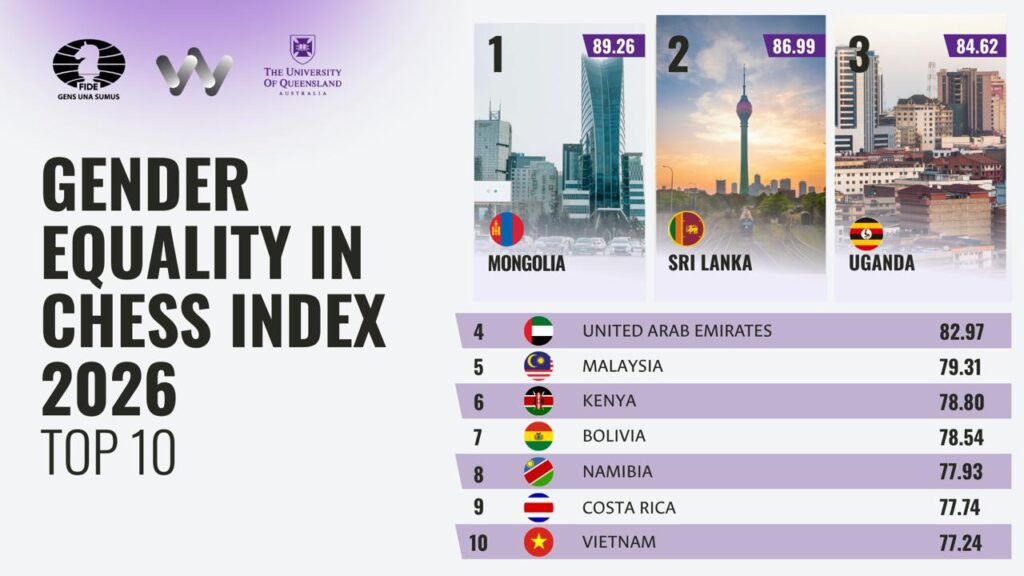
The International Chess Federation, FIDE, has released the second edition of the Gender Equality in Chess Index (GECI) 2026.
The report was published on International Women’s Day by the FIDE Women in Chess Commission together with The University of Queensland. The index measures how well countries are doing in supporting women and girls in chess.
What Is the Gender Equality in Chess Index?
The GECI studies 119 chess federations around the world. It looks at three important areas:
-
Participation – the percentage of female chess players in a country.
-
Performance – how female players’ ratings compare with male players.
-
Progress – the number of girls taking part in youth championships.
These three indicators are combined to create a single score between 0 and 100 for each federation. FIDE plans to update the rankings every two years to track progress in gender equality in chess.
Global Improvement Since 2023
The 2026 report shows clear improvement across the world compared to the first edition in 2023. Average regional scores are:
-
Africa: 67.6
-
Asia: 64.5
-
Americas: 63.1
-
Europe: 56.7
Africa currently leads the rankings, but every region has improved since the previous report. Seventeen federations were ranked for the first time, including:
-
China
-
Turkmenistan
-
Trinidad and Tobago
Top Countries in the 2026 GECI Rankings
The top federations in the 2026 index are:
-
Mongolia – 89.26
-
Sri Lanka – 86.99
-
Uganda – 84.62
The biggest improvement came from the United Arab Emirates, which jumped 73 places from 77th to 4th place. Another strong rise came from the Maldives, which climbed 50 places to 13th.
Inspiring Stories Behind the Numbers
The report also includes real stories from different chess federations that are helping girls and women succeed in chess.
United Arab Emirates
The rapid rise of the United Arab Emirates came from strong cooperation between the chess federation, government ministries, and the national Olympic committee.
One important rule requires girls to be included in all youth championship teams.
Maldives
The Maldives Chess Association made an important change by equalizing prize money between the Women’s and Open tournaments.
They are also launching a new project called “Checkmate Geography.” This program aims to provide chess training across the country’s 1,000+ islands.
Sri Lanka
One of the most inspiring stories comes from Suneetha Wijesuriya, a ten-time Women’s National Champion from Sri Lanka.
As a child, she could not afford a chessboard. So she drew one on the floor with chalk and practiced there. Her story shows how grassroots passion can build a strong national chess culture.
What Experts Say
According to David Smerdon, Associate Professor at The University of Queensland and lead author of the report, the goal of the index is to help federations improve. He explained that data helps federations identify gaps and take action to support female players.
Dana Reizniece, Deputy Chair of the FIDE Management Board, highlighted that gender equality in chess is about people and opportunities. She pointed out that small decisions—like supporting girls in remote areas or including them in youth teams—can transform the chess world.
Anastasia Sorokina, Chair of the FIDE Women in Chess Commission, said the improved rankings are encouraging but there is still more work to do.She encouraged every chess federation to use the GECI report as a starting point for real action.
The Gender Equality in Chess Index 2026 highlights the progress being made around the world.
At the same time, it reminds the chess community that building equal opportunities for women and girls remains an ongoing mission.
Photos: FIDE_Chess
Source: FIDE CHESS NEWS